


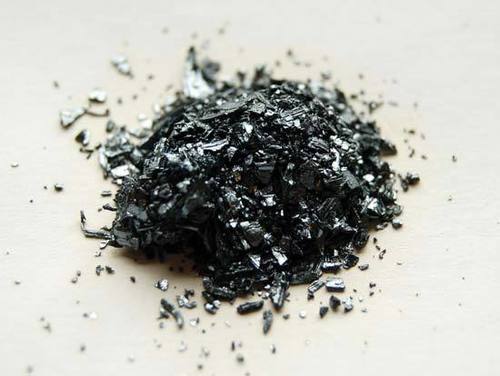
Iodine 7553-56-2 Grade: Lr
Get Latest Price
Brand Name :
Iodine

In Stock
Product Specifications
| CAS No | 7553-56-2 |
| Grade | LR |
| Type | Industrial Lab Chemicals |
| Packaging Details | Iodine is the fourth halogen, being a member of group 17 in the periodic table, below fluorine, chlorine, and bromine; it is the heaviest stable member of its group. (The scarce and fugitive fifth halogen, the radioactive astatine, is not well-studied due to its expense and inaccessibility in large quantities, but appears to show various unusual properties due to relativistic effects.) Iodine has an electron configuration of [Kr]4d105s25p5, with the seven electrons in the fifth and outermost shell being its valence electrons. Like the other halogens, it is one electron short of a full octet and is hence a strong oxidising agent, reacting with many elements in order to complete its outer shell, although in keeping with periodic trends, it is the weakest oxidising agent among the stable halogens: it has the lowest electronegativity among them, just 2.66 on the Pauling scale (compare fluorine, chlorine, and bromine at 3.98, 3.16, and 2.96 respectively; astatine continues the trend with an electronegativity of 2.2). Elemental iodine hence forms diatomic molecules with chemical formula I2, where two iodine atoms share a pair of electrons in order to each achieve a stable octet for themselves; at high temperatures, these diatomic molecules reversibly dissociate a pair of iodine atoms. Similarly, the iodide anion, Ia^', is the strongest reducing agent among the stable halogens, being the most easily oxidised back to diatomic I2.[15] (Astatine goes further, being indeed unstable as Ata^' and readily oxidised to At0 or At+, although the existence of At2 is not settled.)[16]The halogens darken in colour as the group is descended: fluorine is a very pale yellow gas, chlorine is greenish-yellow, and bromine is a reddish-brown volatile liquid. Iodine conforms to the prevailing trend, being a shiny black crystalline solid that melts at 114 AdegC and boils at 183 AdegC to form a violet gas. This trend occurs because the wavelengths of visible light absorbed by the halogens increase down the group (t |
| Main Domestic Market | All India |
| Certifications | Iodine is the fourth halogen, being a member of group 17 in the periodic table, below fluorine, chlorine, and bromine; it is the heaviest stable member of its group. (The scarce and fugitive fifth halogen, the radioactive astatine, is not well-studied due to its expense and inaccessibility in large quantities, but appears to show various unusual properties due to relativistic effects.) Iodine has an electron configuration of [Kr]4d105s25p5, with the seven electrons in the fifth and outermost shell being its valence electrons. Like the other halogens, it is one electron short of a full octet and is hence a strong oxidising agent, reacting with many elements in order to complete its outer shell, although in keeping with periodic trends, it is the weakest oxidising agent among the stable halogens: it has the lowest electronegativity among them, just 2.66 on the Pauling scale (compare fluorine, chlorine, and bromine at 3.98, 3.16, and 2.96 respectively; astatine continues the trend with an electronegativity of 2.2). Elemental iodine hence forms diatomic molecules with chemical formula I2, where two iodine atoms share a pair of electrons in order to each achieve a stable octet for themselves; at high temperatures, these diatomic molecules reversibly dissociate a pair of iodine atoms. Similarly, the iodide anion, Ia^', is the strongest reducing agent among the stable halogens, being the most easily oxidised back to diatomic I2.[15] (Astatine goes further, being indeed unstable as Ata^' and readily oxidised to At0 or At+, although the existence of At2 is not settled.)[16]The halogens darken in colour as the group is descended: fluorine is a very pale yellow gas, chlorine is greenish-yellow, and bromine is a reddish-brown volatile liquid. Iodine conforms to the prevailing trend, being a shiny black crystalline solid that melts at 114 AdegC and boils at 183 AdegC to form a violet gas. This trend occurs because the wavelengths of visible light absorbed by the halogens increase down the group (t |
Company Details
S. R. Chemical Specialities is a legally registered company, which has been delivering finest quality chemicals, acids and many such compositions from years. The firm stands among the top notch manufacturers, suppliers, traders and wholesalers/ distributors of Benzonitriles Structure, Chemical Compounds, Isopar-Hydrocarbon Fluid, Lithium Aluminum Hydride Pellets, Pharma Chemicals, Laboratory Chemicals, Lab Speciality Chemicals, Laboratory Chemicals etc. We have support of highly educated workers and today's technological facilities for preparing and delivering such superio
Business Type
Manufacturer, Distributor, Supplier, Trading Company
Employee Count
5
Establishment
2010
GST NO
36ABGPT6738H1Z6
Related Products

High Grade Glycerine 99.5% (Lab Chemical & Supplies) Cas No: 56-81-5
MOQ - 20 Ton/Tons
Pt Dua Kuda Indonesia
Jakarta, Jakarta
More Products From This Seller
Seller Details

GST - 36ABGPT6738H1Z6
4  Rating
Hyderabad, Telangana
Executive Director
Mr. T. Satyanarayana
Address
4-1-121/61A, VST colony, Nacharam, Hyderabad, Telangana, 500076, India
Lab Chemicals & Supplies in Hyderabad
Report incorrect details