

Needle Valves
(1310 products)

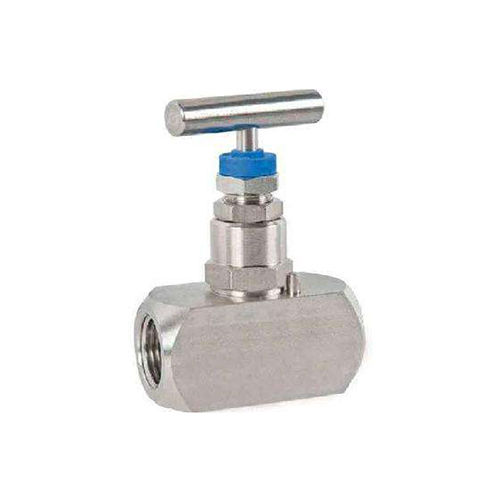
3000-6000 Spi Needle Valve - Application: Industrial
MOQ1 Unit/Units
UsageIndustrial
SizeDifferent Size
Product Type3000-6000 SPI Needle Valve
ColorSilver
ShapeRound
ApplicationIndustrial
Pdq Technologies
Ahmedabad
 Trusted Seller
 Super Seller
3 Years
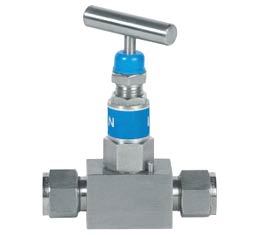
Plug Valves - Screwed Bonnet Design Double Ferrule - Material: Stainless Steel
Price Trend: 200.00 - 2000.00 INR/Piece
MOQ100 Piece/Pieces
StructurePlug
MaterialStainless Steel
A Saluji Engineering Works
Mumbai
Trusted SellerSuper Seller Premium Seller
13 Years

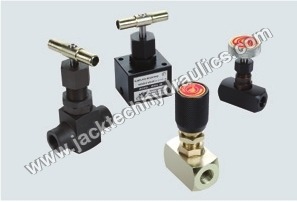
Hydraulic Needle Valves - Corrosion-Resistant, 1/4 to 1 Inch BSP Size, Galvanized Finish | Long Functional Life, Chemical Resistance, High Performance
Price: 400 INR/Piece
MOQ100 Piece/Pieces
StructureNeedle
UsagePipelines
MaterialOther
Surface TreatmentGalvanized
Size1/4 to 1 1/4
PressureOther Bar
Jacktech Hydraulics
Ahmedabad
Trusted Seller Super Premium
14 Years
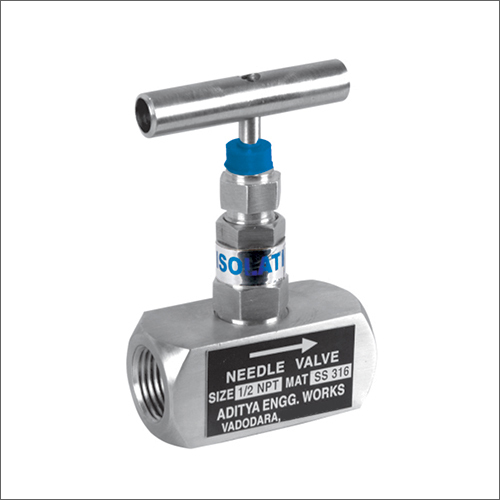
Ss Needle Valve - Application: Industrial
Price: 5000.0 INR/Piece
MOQ10 Piece/Pieces
ConnectionSocket, Thread
ApplicationIndustrial
ColorSilver
StructureNeedle
UsageControl Flow Rates Of Clean Gasses, Fluids
MaterialStainless Steel
Aditya Engineering Works
Vadodara
Trusted SellerPremium Seller8 Years
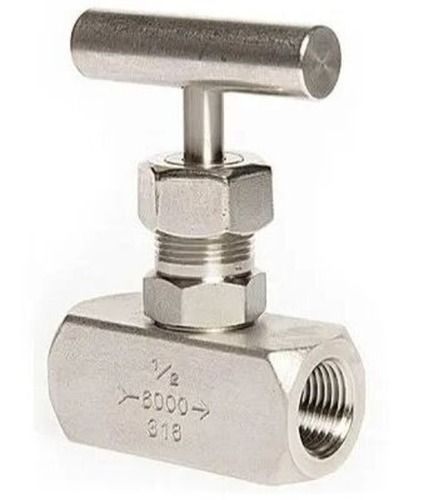
Stainless Steel Needle Valve - Application: Industrial
Price: 850 INR/Piece
MOQ1 Piece/Pieces
ApplicationIndustrial
StructureNeedle
MaterialStainless Steel
Size15mm
Product TypeNeedle Valve
PressureHigh Pressure Pa
Quantum Tech Co.
Ahmedabad
Trusted SellerPremium Seller5 Years

OD Needle Valve
Product DescriptionOur firm is a very reputed voice of the market for delivering a wide range of OD Needle Valve to our consumers. These are widely used in various sectors. Our products are famous for their quality and longer life. These are gettable at a very economical market rates.\015\012
Mig Fitt Engineering Works
Mumbai
Trusted SellerPremium Seller1 Years
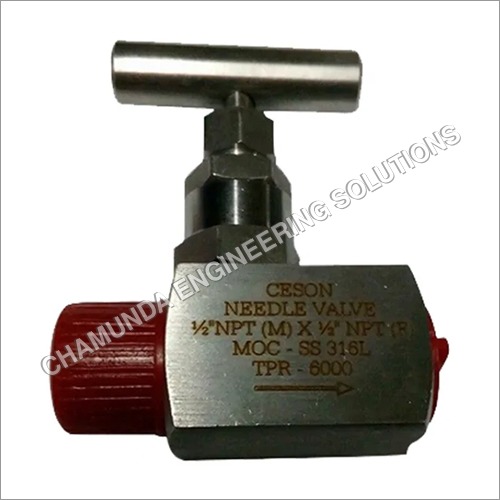
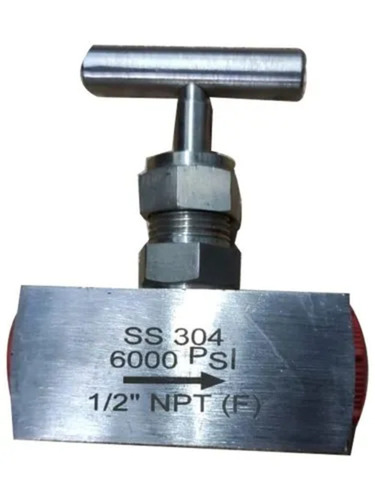
Psi Needle Valve - Color: Silver
Price: 260 INR/Piece
MOQ100 Number
ColorSILVER
StructureNeedle
UsageIndustrial
MaterialOther
Surface TreatmentGalvanized
Size1/2" NPT
Chamunda Engineering Solutions
Ahmedabad
Trusted SellerSuper SellerPremium Seller6 Years
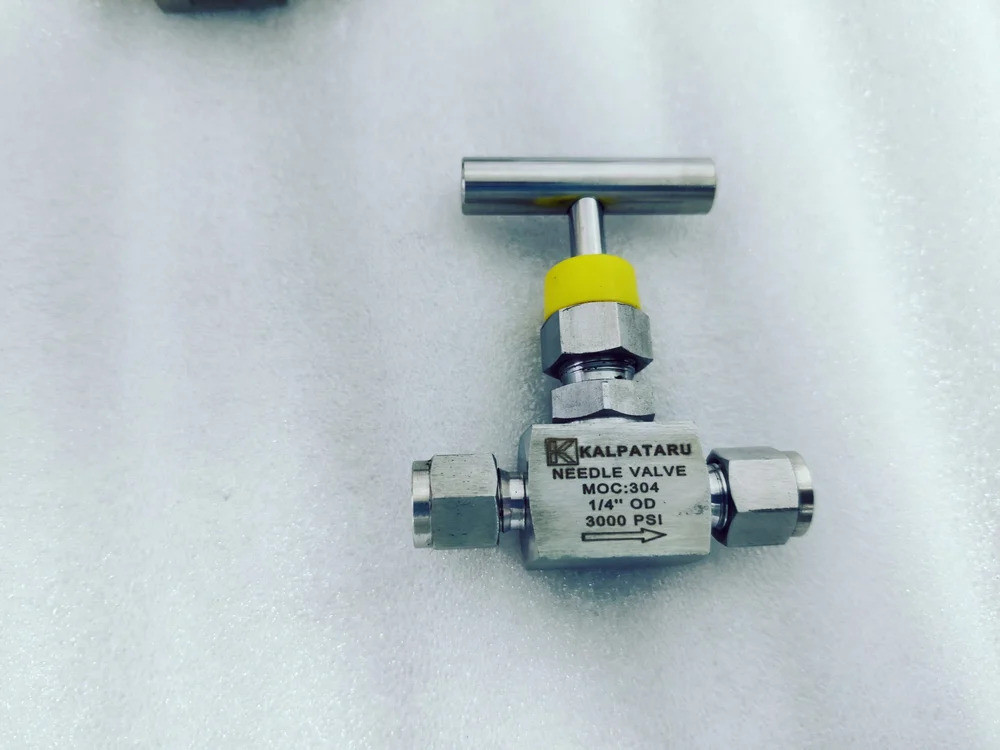
Stainless Steel Double Ferrule Needle Valve
Price: 550 INR/Piece
MOQ10 Piece/Pieces
Temperature of Media-20C to 220C
ApplicationIndustrial Fluid Control
ConnectionOther, Double Ferrule
StructureOther, Bar Stock Body
MaterialOther, SS316 Stainless Steel
Surface TreatmentOther, Polished
Kalpataru Pipe & Fittings
Mumbai
Trusted SellerPremium Seller1 Years
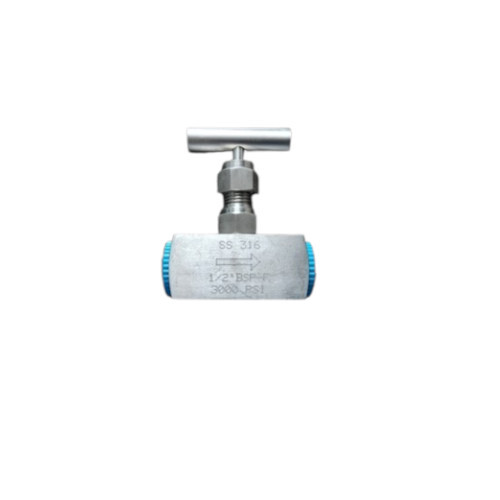
Needle Valves - Stainless Steel, Compact Silver Design | Precise Flow Control for Chemical, Petrochemical, Hydraulic, and Laboratory Systems
Price: 250 INR/Piece
MOQ100 Piece/Pieces
ApplicationChemical, Petrochemical, Water treatment, Hydraulic, and Laboratory systems
ColorSilver
UsagePrecise flow control in fluid systems
MaterialStainless Steel
Product TypeFlow Control Valve
MediaWater
Priti Enterprises
Mumbai
Trusted Seller13 Years
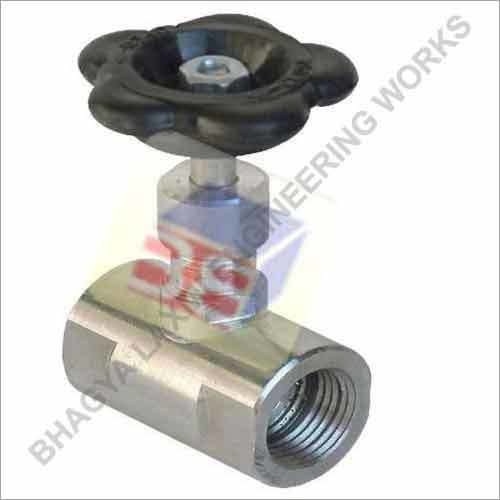
Industrial Needle Valves - Stainless Steel, 1/8-1' Size | Ideal for Liquid and Gas Flow Control, Medium Pressure Use, Galvanized Finish
Price: 1200 INR/Piece
MOQ20 Piece/Pieces
ConnectionOther
ColorGray
ApplicationIndustrial
StructureNeedle
UsageIndustrial
MaterialStainless Steel
Bhagyalaxmi Engineering Works
Ahmedabad
Trusted SellerPremium Seller10 Years
Umiya Instruments
Ankleshwar
Premium Seller3 Years
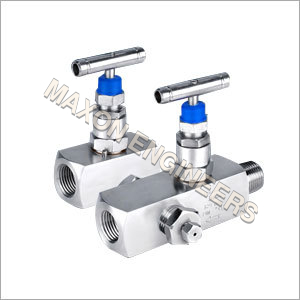
SS Needle Valves
Price: 400 INR/Piece
MOQ10 Piece/Pieces
Supply Ability100 Per Week
Delivery Time3 Days
Maxon Engineers
Ahmedabad
Trusted SellerPremium Seller18 Years
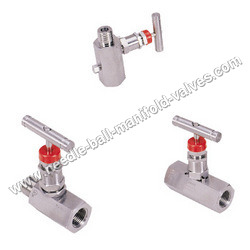
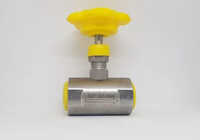
Yellow Ss Needle Valves H B Series
Price Trend: 200.00 - 2000.00 INR/, Piece
MOQ10 , Piece/Pieces
ConnectionThread
Temperature of Media50 Celsius (oC)
UsagePneumatic and Hydraulic
MaterialBrass
Surface TreatmentPlating
Product TypeNeedle Valve
Pioneer Industries
Mumbai
Trusted SellerSuper SellerPremium Seller19 Years

DPL Needle Valves
Product DescriptionNeedle Valves\015\012Product Description :\015\012Two stage shut off, fine regulation and combination of different material and end connection available. Sizes range from 1/8" to 2".\015\012\015\012Application :\015\0121. Chemical, Petrochemical, Fertilizer and food processing industries.\015\0122
Dpl Valves & Systems Pvt. Ltd.
Mumbai
Trusted SellerSuper Seller16 Years
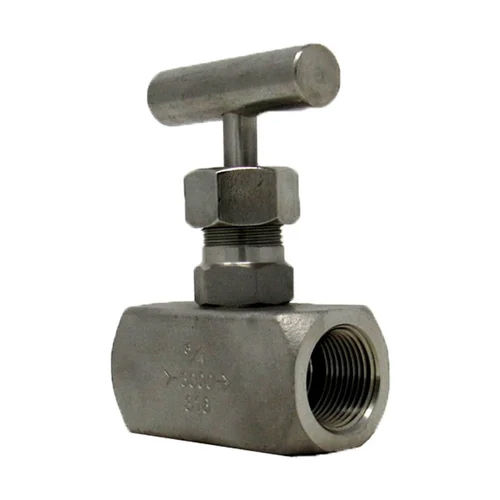
SS Needle Valve - Brass 2 Inch , Silver Industrial Needle Valve with Precise Flow Control
Price: 300 INR/Piece
MOQ10 Piece/Pieces
Temperature of Media-20C to +220C
ColorSilver
ApplicationInstrumentation, Hydraulic, Pneumatic, Oil & Gas, Chemical Industries
ConnectionOther, BSPT/NPT/Compression Fittings
UsageIndustrial
StructureOther, Angle/ Straight Pattern Needle Valve
B. S. Hydro Pneumatics Private Limited
Mumbai
Trusted SellerPremium Seller8 Years
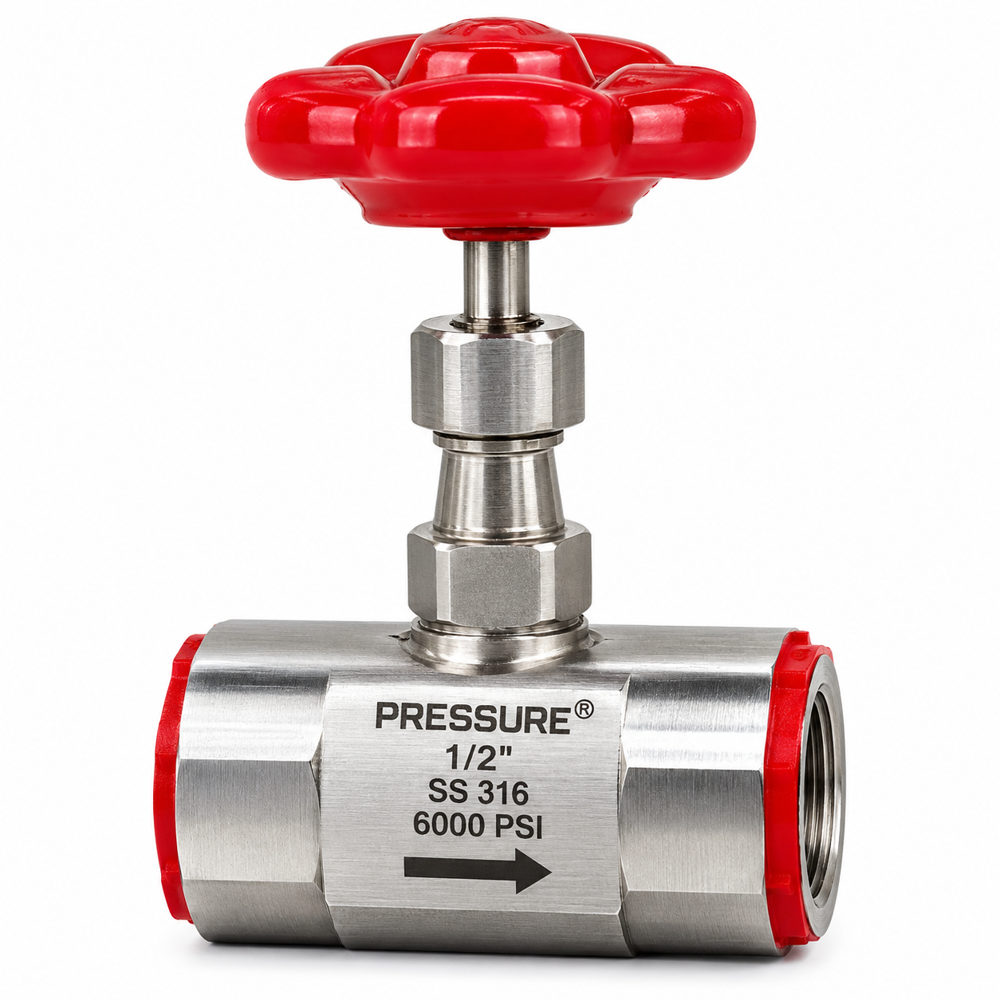
Industrial Needle Valve - Stainless Steel, 80x35x70mm, Silver | High-Pressure Water Control, Metal Seat, Up to 15000 Psi, -54°C to +538°C
Price: 900.0 INR/Piece
MOQ5 Piece/Pieces
ApplicationWater, oil, acid, nuclear waste, other
ColorSilver
Temperature of Media500 Celsius (oC)
ConnectionThread
UsageIndustrial
StructureNeedle
Pressure Valves Private Limited
Ahmedabad
Trusted SellerPremium Seller2 Years

Handmade Flowjet Needle Valves
Product DescriptionBacked by rich industry experience, we are engaged in exporting, manufacturing and supplying of Needle Valves in Ahmedabad, Gujarat, India. These offered products are manufactured using supreme grade quality components that is sourced from reliable vendors of the market keeping in mind set industry
Flowjet Valves Pvt.ltd
Ahmedabad
Trusted SellerSuper Seller5 Years
Unitech Systems
Ahmedabad
Trusted SellerSuper Seller15 Years
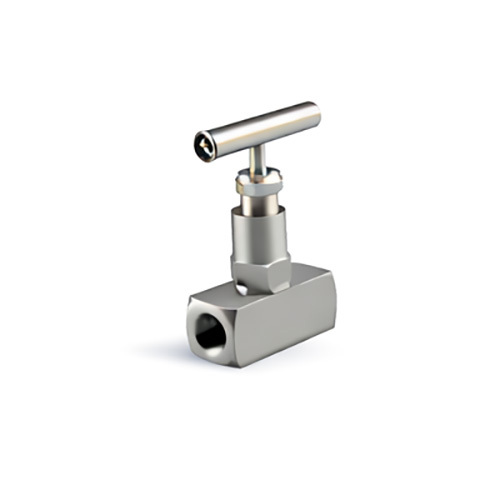
Needle Valve - Stainless Steel, 1/4 to 1 Inch, Rotary Stem | T-Bar or Knurled Handle, PTFE/Graphite Packing, Class VI Leakage
MOQ1 Unit/Units
ApplicationIndustrial, Chemical, Instrumentation, Hydraulic, Laboratory
ConnectionOther, Screwed / Threaded (BSP/NPT)
Temperature of Media-20C to 220C
StructureOther, Needle Type
MaterialOther, Stainless Steel, Brass
Surface TreatmentOther, Polished / Nickel Plated
Nanak 13-13 Exporters
Batala
Trusted Seller1 Years
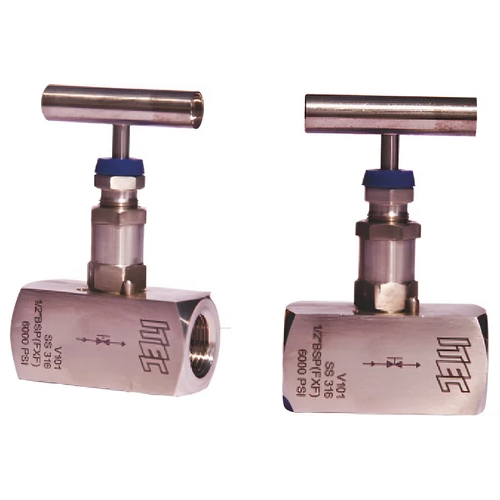
Hign Pressure Needle Control Valves - Color: Silver
Price: 1250 INR/Piece
MOQ20 Piece/Pieces
ColorSilver
ConnectionOther, Screw End
UsageIndustrial
MaterialOther, Mild Steel
Surface TreatmentPowder Coated
MediaGas
Techno Engineering And Solutions
Pune
Trusted SellerPremium Seller2 Years
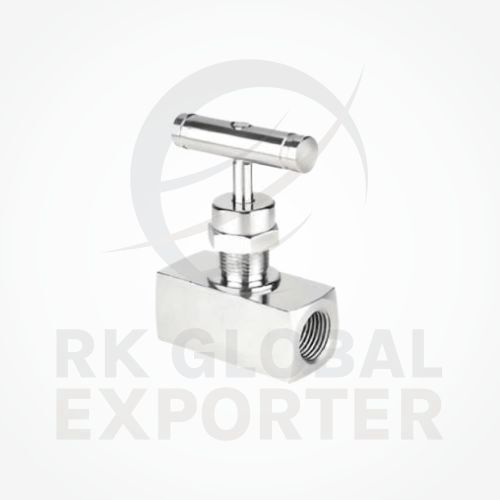
Needle Valve - Color: Silver
Price: 200.0 INR/Piece
MOQ50 Number
ColorSilver
UsageIndustrial
MaterialStainless Steel
Surface TreatmentPolishing
SizeStandard
Product TypeNeedle Valve
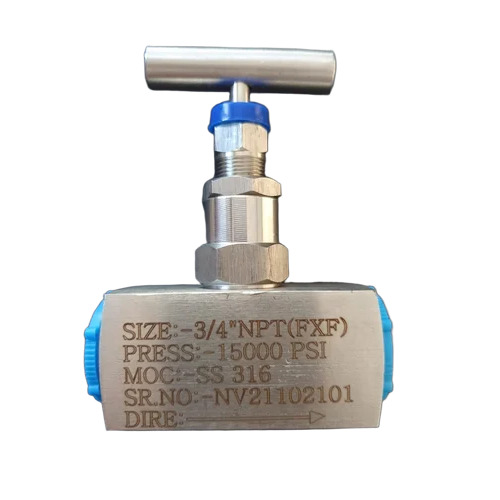
Stainless Steel 316 Needle Valve - Port Size: 3/4"
Price: 1500 INR/Piece
MOQ1 Piece/Pieces
UsageIndustrial
MaterialStainless Steel
Surface TreatmentPolishing
PressureMedium Pressure
PowerHydraulic
MediaWater
Shiv Valves Industries
Ahmedabad
Trusted SellerPremium Seller2 Years
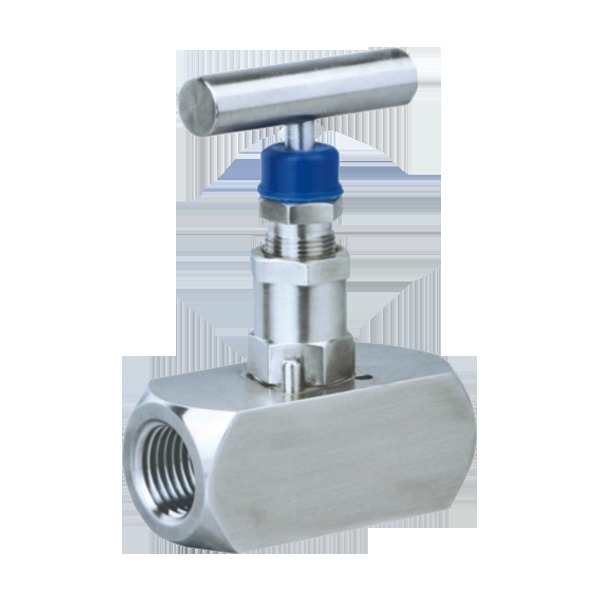
Steel Needle Valve - SS304 Stainless Steel 1/4 Inch, Chrome Finish, 20 Bar Pressure, NPT Threaded
Price: 450 INR/Piece
MOQ10 Piece/Pieces
ConnectionOther, NPT
ApplicationFluid Control
StructureNeedle
MaterialStainless Steel
Surface TreatmentOther, Chrome Finish
PressureOther, Max. 20 bar
Proflow Valves
Thane
Trusted SellerPremium Seller1 Years
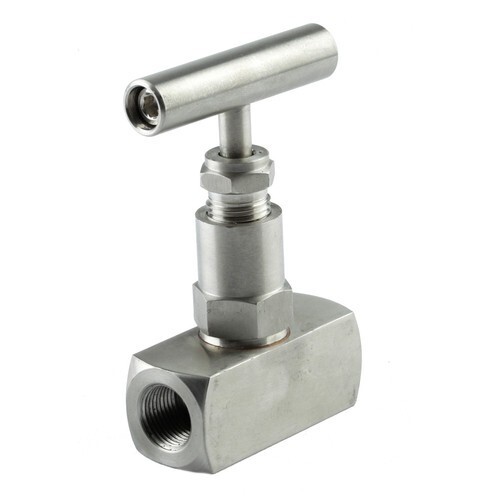
Ss Needle Valve - Application: Industrial Fluid Control
Price: 2000.0 INR/Number
MOQ1 Number
ApplicationIndustrial Fluid Control
ConnectionOther
ColorSilver
Temperature of Media-20AdegC to 180AdegC
UsageIndustrial
StructureControl
Flowbiz Exports Private Limited
Ahmedabad
Trusted SellerPremium Seller4 Years

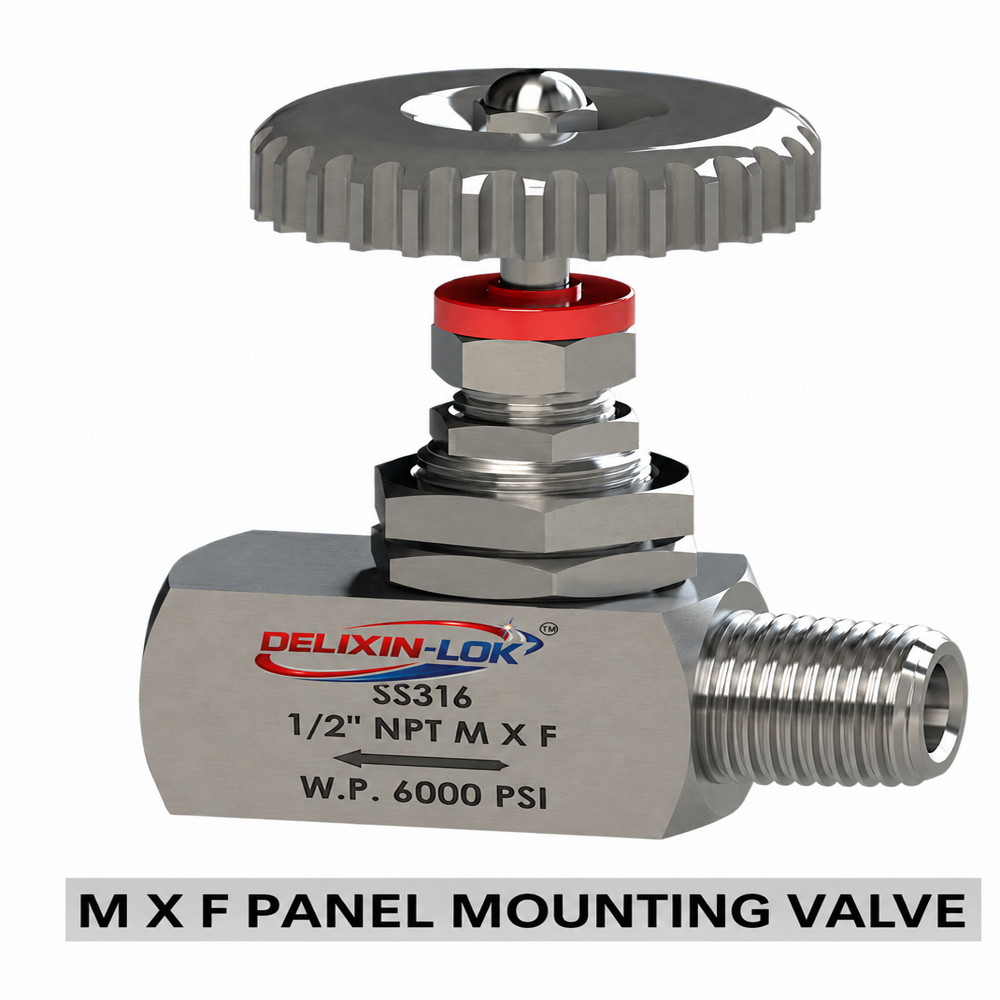
Stainless Steel Needle Valve - 6000psi Pressure, 500F Temperature Resistance | Safe Union-Bonnet Design, Panel Mountable, 100% Factory Tested
Product DescriptionWe are the standout organization which has gained name and fame in distributing and supplying a top quality range of Stainless Steel Needle Valve in Vadodara, Gujarat, India. The durable construction values of these valves allow them to successfully handle working pressure up to 6000psi as well as
Shivani Traders
Vadodara
Trusted Seller11 Years
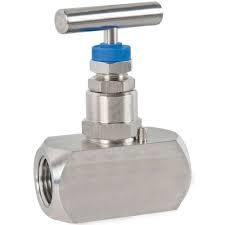
Silver Heavy Duty Ss Needle Valves
Price: 150.00 INR/Piece
MOQ1 Piece/Pieces
UsageUsed for Pipe Fitting
MaterialStainless Steel
Product TypeSS Needle Valves
PressureHigh Pressure PSI
ColorSilver
Kitex Piping Solutions
Mumbai
Trusted Seller8 Years
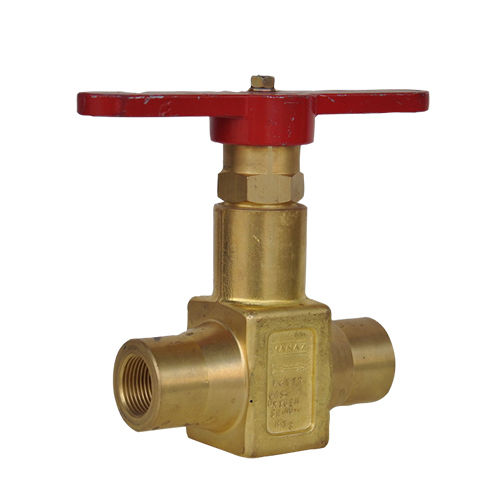
1 Inch Bspf Line Female Valve Application: Industrial
Price: 10500 INR/Unit
MOQ5 Unit/Units
ApplicationIndustrial
ColorGolden
StructureNeedle
UsageIndustrial
MaterialStainless Steel
SizeDifferent Size
Maharashtra Multi Distributors Ltd.
Pune
Premium Seller4 Years
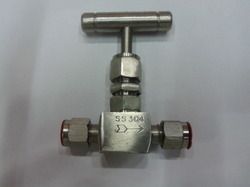
Portable And Durable Stainless Steel Ferrul Needle Valve - Stainless Steel, Silver, Polished Surface | Industrial Use
ApplicationIndustrial
UsageIndustrial
MaterialStainless Steel
Surface TreatmentPolishing
Product TypeFerrul Needle Valve
ColorSilver
S. S. Equipment
Delhi
Trusted SellerPremium Seller9 Years
Latest From Needle Valves
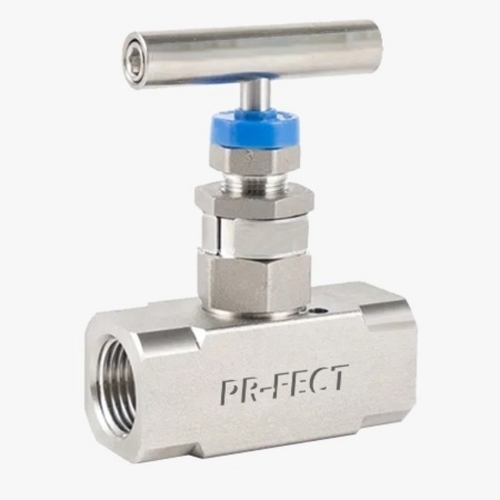
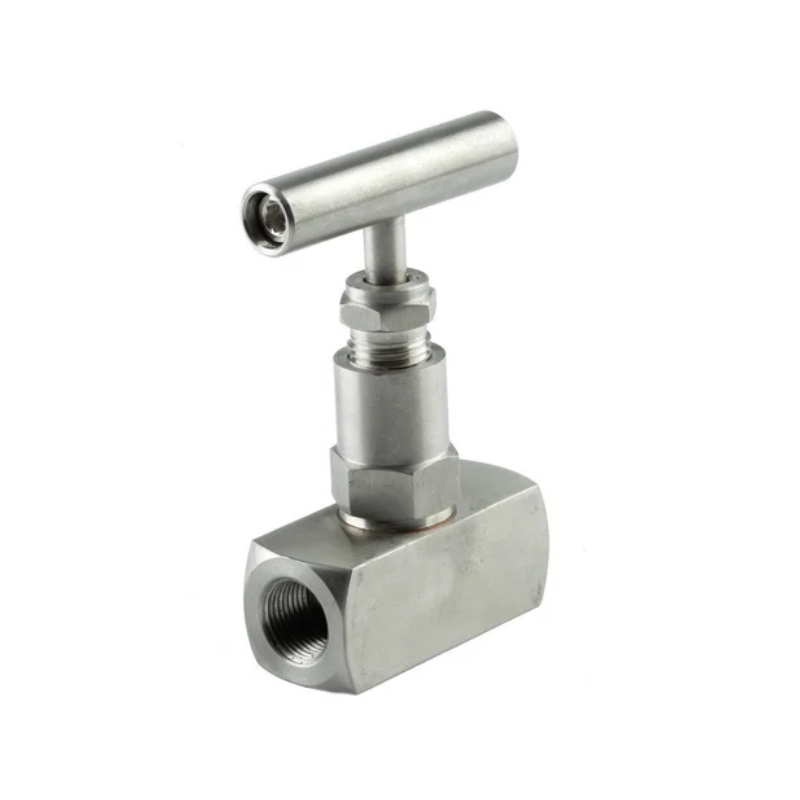
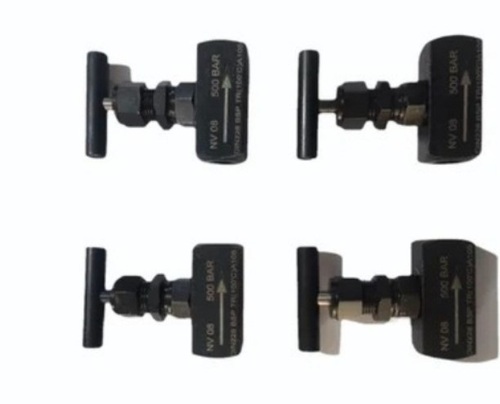
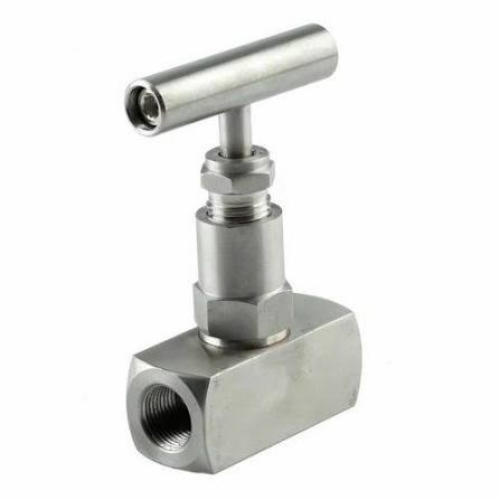
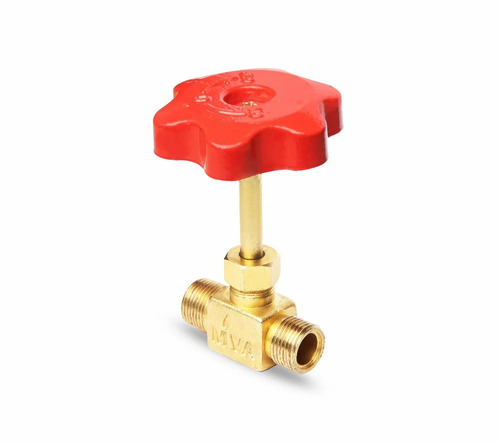
Popular Needle Valves
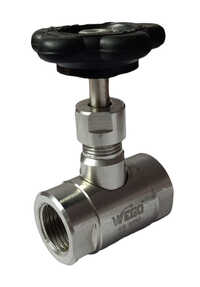
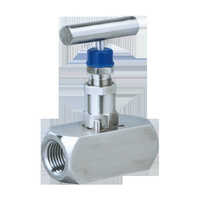
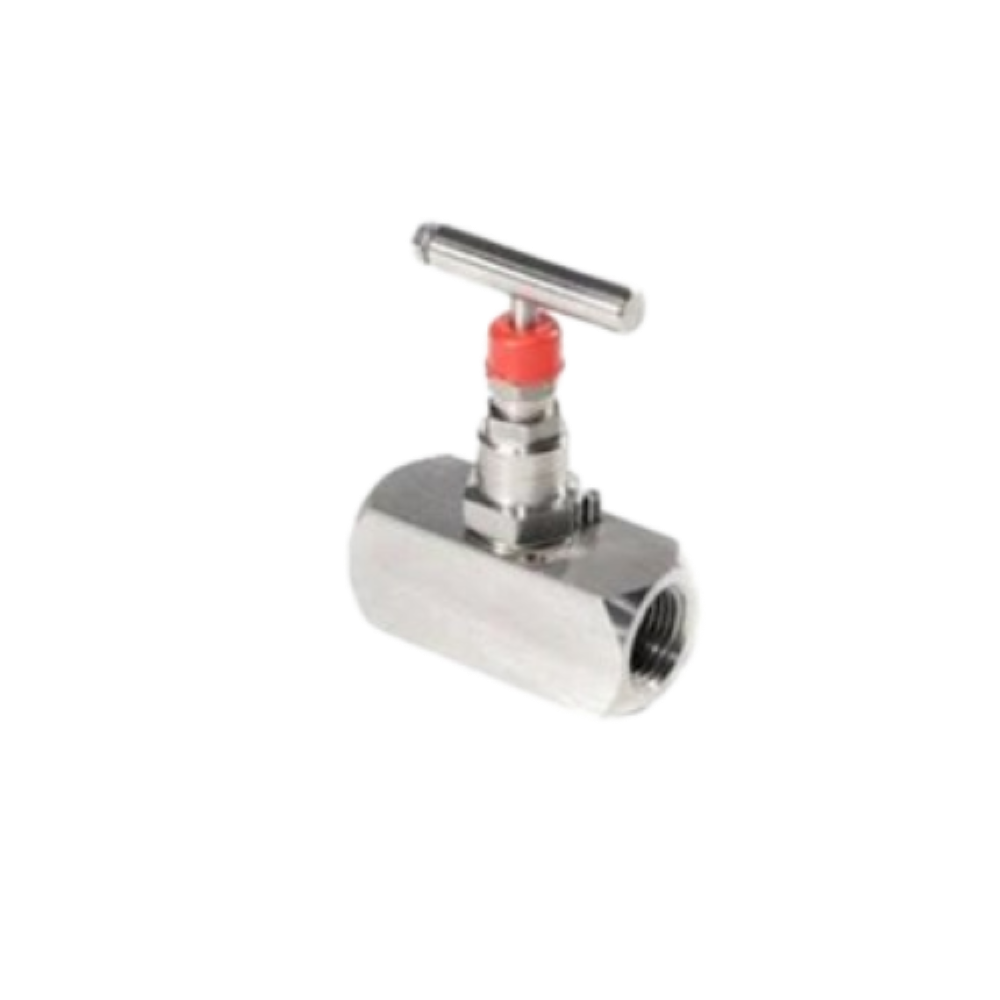
Needle Valves Types, Working & Uses
Introduction
Needle valves are a type of valve used to control the flow of fluids like gas or water in many applications. The little plunger, which resembles a needle, is the item's defining characteristic. The valve may be turned with ease and precision using the handwheel-like grip on the plunger.
The extended end of the valve is designed to precisely fit into the seat, located on the device being controlled. Turning the valve, however, creates a gap between the needle and the seat, allowing only a trace quantity of substance to escape.
Roles of Needle Valves
-
1. Air Regulation
-
2. Turbine by-Pass
-
3. Flow Control
-
4. Pressure Regulation
-
5. Reservoir Inlet
-
6. Flow Discharge
-
7. In Pump Start
Needle Valves Types
The needle valve is utilized in situations when a highly accurate flow measurement is required. Needle valves are more resistant to differential pressure than diaphragm valves. Needless to say, needle valves are not used with slurries or other viscous media since the small aperture is rapidly clogged by thick material or particles.
There are two primary varieties of needle valves, both of which are discussed here.
a) - Inline Needle Valve
The ports for inflow and outflow on these valves are aligned in a straight line. In most cases, a straight line flow system is the best option for installing these valves.
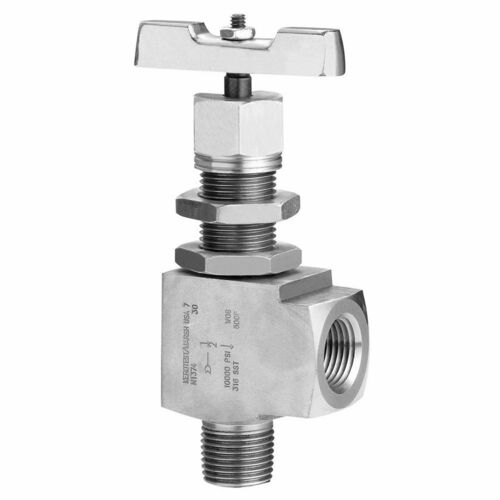
b) - Angle Needle Valve
The inlet and output of these valves are at an angle. The inlet and the outlet are often set at right angles to one another for seamless integration into the system. This valve is installed at a 90-degree turn in the pipe system.
Parts of a Needle Valve
1. Handle
A valve's manual operation is performed via a handle located outside the valve body. In most cases, automatic valves don't have handles, although a stop-check valve, for example, might provide a way to override the system.
2. Set Screw
When mounting a pulley or gear to a shaft, for example, a set screw is used to tighten the component against the shaft by pressure and/or friction. To distinguish it from a bolt, a set screw is often used without a nut and is threaded into a hole bored into just one of the two items being fastened. Set screws are sometimes known as grub screws or blind screws since their entire length is threaded rather than just the tip.
3. Stem
The power screw on the stem converts the rotational motion of the hand wheel into a vertical motion, which is then sent to the plug, where it is used to seat the disc in its seat and seal off the flow opening.
In order to connect the stem of the valve to the hand wheel, there are four flat edges at the top that thread into the power screw and are then locked in place with a nut.
The disc stem nut is used to connect the plug into the stem at the bottom. The stem will experience torsional forces generated by the power screw.
4. Body
Valve bodies, often called shells, are the primary component of needle valves. The body is the primary part of a valve assembly since it is the structure that holds everything in place. The body, or initial pressure barrier, of a valve is what holds back the pressure of flowing fluid in the pipes that are connected to it.
5. Gland
The packing gland is a component of the valve that is put into the bonnet to keep the stem packing in place. The top of the packing gland is used in conjunction with the bottom bearing set of the stem adapter to ensure the Needle Valves operate smoothly.
6. Bonnet
The opening of the valve is closed by the bonnet. The valve's body serves as the service load bearing element of the device, supporting the full pressure of the fluid being routed through the valve. It is secured using a threaded stud and nuts.
The gland is supported by the bonnet, which in this case is composed of bronze because that is the same material used for the valve body.
7. Other Parts
Packing, Stem, Nut, Handle Screw, O Ring and others are some main parts of Needle Valve
Needle Valves Working
To stop or start the flow of liquid or gas via a tube, a needle valve relies on the idea of restricting or allowing the movement of the needle section of the valve. Let's analyze the steps involved. While there are many moving parts within a needle valve, the needle and the seat are the most crucial for the valve to function. The needle is the conical plunger that can be retracted from the channel or pushed into it to regulate the flow. The point at which a needle enters a pipe carrying fluid or air is called its "seat." The seat is the depression into which the needle fits. Both the needle and the seat are made to be precise fits in their respective locations.
When the needle is in place and pressed all the way down, there will be no spaces through which gas or liquid can escape. It was on purpose that they came out to be just the right size. The needle valve's exterior features a handle that the user can hold and attach to the valve's stem. This handle can take the form of a bar handle or a rounded handle. The needle is threaded like a screw and inserts into the seat from the inside. The needle valve is activated by turning the stem, which is done by grasping the handle in a manner that allows for effortless rotation. The threaded sides turn as the needle spins, allowing you to raise or lower the needle from its seat.
Needle depth changes are disguised by the threading, so they are barely perceptible at each turn. With this, the needle's position may be adjusted to within a few hundredths of a degree, allowing for the greatest possible precision. Once the flow is stopped, the observant mind may immediately recognize the possible danger of the entire component becoming over-pressurized and being unable to withstand the resulting pressure. However, the reality remains that the item's compact size is what allows it to function. As the aperture is relatively small in relation to the rest of the body, high pressure is not an issue. On the other hand, the restricted flow rate is usually not a good fit for the small opening.
Needle Valve Uses
They excel in small channel applications requiring precision flow regulation and accurate calibration. Many different types of businesses rely on needle valves for fluid control. The following are just a few of the many uses for a needle valve:
-
(i) - In order to regulate the flow of liquid, a needle valve is built into all analog field instruments.
-
(ii) -When a controlled, steady reduction in flow rate is required, needle valves come in handy.
-
(iii) -The needle valve functions as both an on/off switch and a control for the flow rate.
-
(iv) -Steam, air, gas, oil, and water are just few of the fluids for which this can be used as a meter.
-
(v) -When only a small amount of flow is needed at a sample point in the pipe, a needle valve comes in handy.
-
(vi) -The gas bleeder lines can use this valve.
-
(vii) -When precise flow management is necessary, automated combustion control systems use needle valves.
-
(viii) -Combined with a constant pressure pump governor, it smoothes out the flow from the pump and minimizes fluctuations.
Many different needle valves can be used to control the flow rate through a pipe or other opening; this is a function shared by all valves. However, each kind has its own set of pros that may make it better suited to some jobs than others. Needle valves have their own unique benefits; yet, this does not make them the greatest valve available. Rather, it is more appropriate to say that the needle valve is the optimum valve when extreme precision and accuracy are required, such as in the scenarios we discussed.
FAQs: Needle Valves
Q. What is a needle valve?
Ans. The needle valve is a specific kind of valve characterized by an extremely constrained port and a plunger in the shape of a needle that can move up and down in the valve's opening. It gets its name because it looks like a needle inside a syringe.
Q. What is the advantage of needle valve?
Ans. Here are the advantages:
-
(i) -This valve allows for precise control of flow at low rates.
-
(ii) -Tiny needle valves are used. Since this system does not require a lot of room to set up, it can be easily installed in almost any environment.
-
(iii) -This valve enables throttling with a reduced fluid volume.
-
(iv) -A fine degree of control is available over the flow rates.
-
(v) -The system can be used with less effort.
Q. What are needle valves used for
Ans. Chemical processing, Low-pressure hydraulic systems, and other gas and liquid services frequently employ needle valves. Due to the materials used, these valves can be used in environments with high temperatures and oxygen.
Q. What is difference between needle valve and ball valve?
Ans. A ball valve's sole purpose is to open and close. If possible, keep your engine from being slowed for too long while Needle valves' versatile designs allow for on/off, throttling, and precision metering operation, giving you a wide range of control over the flow of fluid.
Manufacturers & Suppliers of Needle Valves
Company Name | Member Since |
|---|---|
Pioneer Industries Mumbai, India | 19 Years |
Maxon Engineers Ahmedabad, India | 18 Years |
Dpl Valves & Systems Pvt. Ltd. Mumbai, India | 16 Years |
Unitech Systems Ahmedabad, India | 15 Years |
Jacktech Hydraulics Ahmedabad, India | 14 Years |
A Saluji Engineering Works Mumbai, India | 13 Years |
Priti Enterprises Mumbai, India | 13 Years |
Shivani Traders Vadodara, India | 11 Years |
Bhagyalaxmi Engineering Works Ahmedabad, India | 10 Years |
S. S. Equipment Delhi, India | 9 Years |




© 1999-2026 Infocom Network Private Limited. All rights reserved.