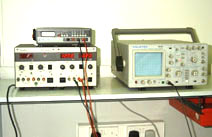
 What is an Electronic Testing Equipment?
Electronic test equipment is a testing instrument used to create stimulus signals and capture responses from electronic devices under test. Faults in the device can be traced and repaired after detection by the electronic testing equipment.
The demand for electronic testing equipment has risen in various industries today. Use of electronic test equipment is indispensable for any serious work related to electronics systems. The engineering industry requires the use of many different kinds of electronic test equipment ranging from the very simple and inexpensive to extremely complex and sophisticated ones.
Advanced electronic testing equipment are a must in any manufacturing unit that manufactures electronic devices or other related engineering products. After the manufacturing is completed, the final product is again subjected to various tests, which has also increased the demand of electronic testing equipment in the market.
What are Electronic Systems?
Electronic systems facilitate the flow of charge through various materials and devices such as, semiconductors, resistors, inductors, capacitors, nano-structures, and vacuum tubes. They are used to perform a wide variety of tasks. The main uses of electronic circuits are as follows:
Controlling and processing of data
Cconversion to/from and distribution of electric power.
Types of Electronic Testing Equipment
Basic Equipment for measurement of voltages, currents, and components
Advanced or Less Commonly Used Equipment
Miscellaneous Devices.
Basic Equipment for measurement of voltages, currents, and components
The Electronic Testing Equipment under this category includes the following:
 |
- Voltmeter (Measures voltage)
- Ohmmeter (Measures resistance)
- Ammeter (Measures current)
- Multimeter (Measures all of the above)
- Power supplies (for stimulus testing)
- Signal generator (for stimulus testing)
- Pulse generator (for stimulus testing)
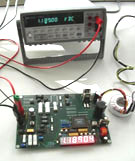
- Howard piA digital multimeter
- Howard piA digital multimeter
- Oscilloscope (Analyzes response)
- Frequency counter (Measures frequency)
- Test probes (All the above).
|
Advanced or Less commonly used equipment
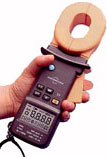
- Meters: Solenoid voltmeter (Wiggy), clamp meter (current transducer), wheatstone bridge (precisely measures resistance), capacitance meter (measures capacitance), EMF Meter (measures electric and magnetic fields), electrometer (measures charge)
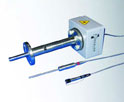 Probes: RF probe, signal tracer Probes: RF probe, signal tracer
- Analysers: Logic analyzer (tests digital circuits), spectrum analyzer (SA, measures spectral energy of signals), vector signal analyzer (VSA, like the SA but it can also perform many more useful digital demodulation functions), time-domain reflectometer for testing integrity of long cables
- Signal-generating devices: Signal generator, frequency synthesiser, function generator, pulse generator, signal injector.
|
Miscellaneous Devices
 |
- Continuity tester
- Cable tester
- Hipot tester
- Network analyzer (used to characterize components or complete computer networks)
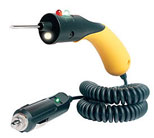
- Test light
- Transistor tester.
|
Commonly Used Electronic Testing Equipment
Battery Testers and Fuel Cell Test Equipment consisting of specialized test stations, stands or systems, monitors and component modules for performance or endurance testing
Burn-in Test Equipment which uses elevated voltages, temperatures and power cycling to evaluate high power chips, boards or products
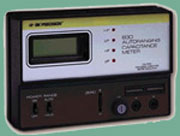 Capacitance Testers
 used to test the capabilities and performance of capacitors
Current Leakage Testers that measure the amount of current that leaks to the ground
EMI and RFI Testers used to monitor the presence of unwanted electromagnetic and radio frequency radiation
Ground Bond Testers, which are electrical safety test devices that perform electrical compliance tests
Harmonic Distortion and Phase Meters that measure harmonic distortion or phase position
Hipot Testers, which are electrical safety test devices that perform a variety of electrical compliance tests
Megohmmeters that generate high voltage, low current signals for testing the breakdown strength of electrical insulation
Noise, Vibration and Harshness (NVH) Test Equipment used to test and monitor noise, vibration and harshness in mechanical and electrical systems
RF Field Intensity Meters that measure the strength of an electromagnetic field. They are used to detect buried or hidden piping, equipment or ferromagnetic ores.
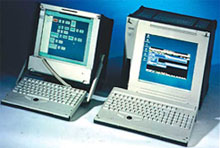 RF Test Equipment
 that generates test signals or analyzes transmitted signals from RF components or equipment
Electrical Test Probes used to establish a connection between a circuit under test and the measuring instrument
Transformer Test Equipment consisting of specialized test modules or systems used to test and/or monitor electrical and mechanical parameters of transformers and other related devices.
History of the Invention of Electronic Testing Equipment
After Volta's battery was invented in 1600, the first utilization of electricity was in telegraphic communication. At that time, neither voltage nor current needed to be measured regularly. Measurement was necessary only at times of failure or in preparation. Even when trans-Atlantic telegraphic communication was successfully completed in 1866, the Kelvin Mirror Galvanometer was used as a telegraphic receiving instrument.
When the electric power industry began to develop in the second half of the 19th century, current and voltage needed to be measured regularly. One of the engineers who put the precision DC ammeter into practical use naming it as Portable Instrument was Edward Weston. In 1886, Weston completed a portable DC ammeter with an accuracy of 0.5%, and subsequently invented stable resistance called Manganin--an ammeter for large currents and an AC meter.
In 1892, J. A. Fleming, Edison's British adviser, became interested in the "Edison effect" and attempted to carry out supplementary examinations. In contrast to Edison's method, he put a metal plate, then a cylinder into the electric bulb, naming the equipment an "Oscillation Valve". E. Doyle and L. Chubb applied this valve to the measurement of high voltages.
Following Thomas Edison’s invention of electrical light in 1896, it became necessary to address the safety hazards and performance variances of electrical lamps. Since that time both the electrical product and electrical product testing industries have grown significantly.
I. Langmuir of GE invented a durable tube with high power, using a high vacuum. The vacuum-tube voltmeter incorporated this tube as an amplifier or a wave detector called a Valve-Voltmeter or Vacuum-Tube Voltmeter. The first vacuum-tube voltmeter was invented by E.B. Moullin of the University of Cambridge in 1922, and was put on the market as the product of the Cambridge Scientific Instrument Company. Several kinds of voltmeters were then manufactured.
H. S. Black devised a negative feedback circuit in 1927 through the study of the carrier telephone amplifier of Bell Laboratories. This circuit improved the stability of the amplifier and its nonlinear nature, and the way to quantitative measuring instruments was established.
A. D. Blumlein invented the differential circuit in 1936, and a more stable DC amplifier was realized. Meters featuring the ability to measure from a direct current to a high frequency on a linear scale, and with no requirement for zero point adjustment, were also manufactured.
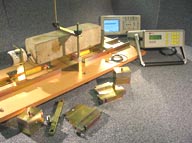
In the 1950s, the practical small vacuum-tube voltmeter using a miniature tube was finally completed. Moreover, the meter became easier to use because a linear scale was created using negative feedback. The dual slope analog-to-digital conversion circuit, developed in 1957, was an excellent circuit for measuring instruments.
The above historical abstract is on voltmeter. The first electronic measuring instruments were physically impossible to transport, and were functionally inadequate for use in a laboratory. The measuring instruments of today have evolved into easy-to-use instruments with higher performance, adopting new active components developed one after another. Testing instruments that have adopted such new technology have enabled even more precise measurement. A number of electronic testing equipments were developed with time and the innovation still continues.